ASTS Advocacy Day in Washington: Advancing Transplant Policy and Patient Protection
Written by Stephanie Yi, MD, MPH, Chair of the ASTS Living Donor Committee (2025-2026)
Every Fall and Spring, members of the American Society of Transplant Surgeons (ASTS) gather virtually and in-person to engage with lawmakers, federal agencies, and policy staff in Washington, D.C. as part of the ASTS Advocacy Day. These meetings are a cornerstone of the society’s efforts to influence legislation and regulatory action that directly affects transplant surgeons, patients, and donor communities. For many participants, this annual event offers a rare opportunity to bring frontline clinical expertise and personal stories directly to Capitol Hill. This past year’s in-person Advocacy Day once again highlighted several critical national priorities, including the modernization of the Organ Procurement and Transplantation Network (OPTN), support for living donor rights through the Living Donor Protection Act (LDPA), and discussion regarding the potential cuts to NIH funding as they pertain to research in transplantation. ASTS members were joined by prior living organ donors and transplant recipients, who provided the real-life experiences to the important topics discussed.
 Advocacy Day started with a briefing meeting to discuss each piece of legislation, and participants received briefing documents summarizing key points. The first piece of legislation was the Organ Procurement and Transplantation Network (OPTN) Modernization Initiative. First introduced in March 2023 as the “Securing the OPTN Act”, the OPTN Modernization is a Health Resources and Services Administration (HRSA) led initiative to update the technology infrastructure to improve accountability and transparency of the organ allocation system in the United States. HRSA is tasked to assigned government contracts to multiple vendors to modernize OPTN operations. While the ASTS strongly supports modernization efforts for the OPTN, there is concern that this new system will leave less oversight and prioritization on patient care. With the recent change in HRSA’s leadership, the ASTS asked for a pause in OPTN modernization efforts so that there be a review and public discussion of the current modernization efforts.
The next legislation item was the Living donor Protection Act (LDPA), which is a widely supported bipartisan and bicameral bill aimed to protect living organ donors’ access to insurance and employment. The LDPA has two components: to prohibit healthcare and life insurance discrimination based on one’s living donor status and to amend the Family and Medical Leave Act of 1993 (FMLA) to include living organ donation as a serious health condition. Since its introduction, the LDPA has had no opposition and has been strongly supported among national surgeon, physician and patient groups. The LDPA has also had a preliminary congressional budget office (CBO) score of zero in the 118th Congress.
The last item of discussion was informing Congress about the impact of reduction in indirect cost for NIH funding in transplantation. This item was to urge Congress to reject proposals that would that reduce NIH funding of indirect cost, which would impede crucial transplant research. Critical institutional infrastructure, such as laboratories, biorepositories and computational platforms, depend on this funding, and are important for transplant research.
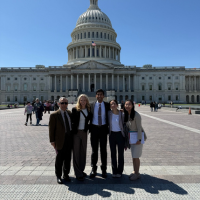 Although last spring’s advocacy day occurred when congress was in recess, participants (who also enjoyed the beautiful warm spring day) embraced the opportunity to engage with Hill staffers at a more relaxed and slower pace. First time Advocacy participants Ronit Patniak and Gazi Zibari were joined by Living Donor committee members Lisa Thomas and Stephanie Yi, as they visited the offices of Senators Marco Rubio (FL), John Cornyn (TX), and John Kennedy (LA). Dr. Zibari discussed the importance of maintaining federal funding for research, such as in xenotransplantation, while enthusiastically pointing to general surgery resident and now transplant fellow Ronit, as representing the future of transplant.
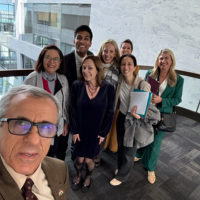 ASTS leadership was also present, including ASTS past president Ginny Baumgardner and Healthcare lobbyist Peggy Tighe. They provided the extra push and expertise when visiting representative offices who have yet to support the proposed legislation.
The ASTS Advocacy Day, while one of the main events of the Legislative and Regulatory committee, is an incredible opportunity for other ASTS committee members, from the Living Donor committee to the Surgeon Scientist committee, to engage law makers in policy changes impactful to the future of transplantation. Step outside of the OR and come advocate for improving patient care and expanding access to transplantation.
The next ASTS Advocacy Day ins April 29th -30th. Registration is now online.