News
National Minority Donor Awareness Month: Hear from Maribel Costell
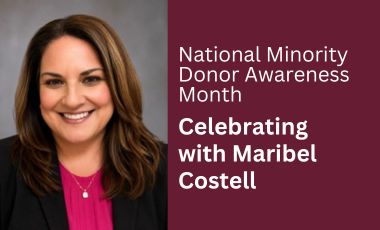
Can you tell us a bit about your donation story — what led you to donate, and what was that journey like for you?
Growing up, I formed a special bond with my elderly neighbor and naturally gravitated toward her warm presence. Some of my earliest memories include being mindful of her dialysis schedule, she had hemodialysis three times a week and gave her space on those days, knowing she needed rest. At the time, I didn't fully understand kidney disease, but I understood her.
Years later, life brought kidney disease even closer to home when my father received his diagnosis. With his limited health literacy and education, he needed someone by his side, and I stepped into the role of his care partner wholeheartedly. Through countless nephrology and transplant appointments, I immersed myself in learning everything I could about kidney disease not just for him, but because I genuinely wanted to help.
When my father was approved for the transplant list, I didn't hesitate to offer myself as a living donor. However, he declined. He held onto some common misconceptions about living donation and quietly hoped that one of my brothers might come forward. Ultimately, he chose to wait for a deceased donor, and I respected his decision.
Around this same time, I met my husband and, in a moment, I'll never forget, I noticed a dialysis fistula on his arm. That small detail sparked a deep connection between us, rooted in a shared understanding of this journey. He had previously received a kidney transplant, and we built our lives together. But shortly after we married, he experienced kidney failure for the second time and found himself back on dialysis. Because I was his primary caregiver and a mother to a young daughter, I was unable to be tested as his donor. Instead, we poured our hearts into spreading awareness of his need, and we were truly blessed when a generous soul came forward and gave him the gift of a kidney.
When my father's turn finally came, he received a deceased donor transplant but the road ahead was far from easy. The kidney experienced delayed graft function and unfortunately never fully took hold. It was a heartbreaking setback after such a long and hopeful wait. As his medical team carefully evaluated his options, it became clear that given his age and overall health, a living donor transplant offered him the best possible chance at a meaningful recovery and quality of life.
Witnessing my husband's remarkable recovery after his transplant had already moved my father deeply. And now, faced with the reality of his situation, he finally opened his heart to the idea and was open and asked me to come forward to be tested as his potential living donor.
How did your Hispanic heritage influence your experience?
I was born in the border town of Tijuana, Mexico. When my family immigrated to the United States, Spanish was the only language I knew. But as soon as I found my footing in English, I naturally stepped into the role of advocate. Accompanying my parents to their medical appointments and making sure their voices were heard and understood
From an early age, I carried a deep desire to enter the medical field. Life, however, had its own path in store for me. While my journey looked different than I once imagined, my passion never wavered. Instead, it evolved into something equally meaningful, a lifelong commitment to empowering and advocating for those in the Hispanic community who struggle to navigate the healthcare system due to language barriers or limited health literacy.
I have always believed that every patient deserves the same quality of care, regardless of their background, education, or ability to communicate their needs. Not every patient walks through the door with the same level of understanding, and some simply need a little more guidance, patience, and compassion along the way. To me, that is not a burden, it is truly an honor.
Watching those I love most be touched by kidney disease has been both heartbreaking and profoundly transformative. Seeing my father and my husband navigate the challenges of kidney failure, dialysis, and transplantation firsthand gave me a perspective that no classroom could ever teach. Those deeply personal experiences did not just shape who I am. They have driven me toward a career where I can make a real difference by spreading awareness about the critical importance of organ donation, particularly within communities that are often underserved and underrepresented.
Being a first-generation college graduate in my family is something I carry with immense pride. It is a testament to the sacrifices my family made and a reminder of why I continue to show up every day for those who need someone in their corner, and for those still waiting for the gift of life.
We know the healthcare system has not always earned the trust of Hispanic communities, and this can make living donation feel intimidating. What helped you develop trust in your care team, and were there particular moments that made you feel safe, respected, and supported?
I was very fortunate to have wonderful care team and transplant surgeon during and after my donation journey. However, low health literacy, language barriers, and cultural differences can create significant challenges for patients navigating the healthcare system and, in many cases, these obstacles can quietly erode trust between patients and their care teams. When patients feel misunderstood or unable to fully express their needs, that disconnect can have a profound impact on their health outcomes and overall well-being.
As community partners, we have both the privilege and the responsibility to do better. By becoming more attuned to the unique needs of everyone we serve, we can begin to bridge that gap with intention and compassion. This means leading with patience and truly listening without rushing. It means empowering patients to take an active role in their own healthcare journey, rather than simply receiving information passively. It means providing education in their native language, so that nothing is lost in translation and every patient fully understands their options and choices.
Perhaps most powerfully, it means connecting patients with mentors. Individuals who have walked a similar path can offer not just guidance, but genuine understanding and hope. Sometimes, hearing "I have been where you are, and there is a way forward" can make all the difference in the world.
When we show up for our communities in these meaningful ways, we do not just improve healthcare experiences, but we help restore trust, dignity, and hope for those who need it most.
Are there cultural relationships/impressions within your community about organ donation or transplantation that you’d like others to understand better?
There are many myths and misconceptions surrounding living donation and organ donation in general. It is completely natural to have questions or hesitations. These misunderstandings can often feel overwhelming, but the good news is that knowledge is one of the most powerful tools we have. I wholeheartedly encourage anyone who is considering or curious about living donation to take that first step and research, ask questions, and seek out the information that can help bring clarity and confidence to such an important decision.
One of the most meaningful things you can do is connect with those who have lived the experience firsthand. Reaching out to previous donors and building relationships with mentors who have walked this path can offer a perspective that goes far beyond what any pamphlet or website can provide. Their stories, their honesty, and their reassurance can be truly transformative.
I also encourage everyone to sit down with a transplant team and have an open, honest conversation. Understanding the differences between living donation and organ donation after death including the associated risk factors and benefits of each. These are all essential in making an informed and empowered decision.
It is also important to remember that we do not always hear success stories. Too often, we hold tightly to negative experiences and perceptions, allowing fear to overshadow the countless lives that have been beautifully transformed through the gift of donation. The success stories are out there, and they deserve to be heard, celebrated, and shared.
What would you like healthcare professionals to better understand about caring for Hispanic donors?
One of the most important things I would want healthcare professionals to understand is that Hispanic donors simply want to feel heard. It is not just about receiving information, it is about feeling seen, respected, and valued throughout every step of the process.
Taking the time to truly listen, answer questions with patience and without judgment, and acknowledge the unique cultural values that shape a patient's perspective can make an enormous difference. Empathy is not just a soft skill; it is a cornerstone of exceptional care.
Cultural awareness is equally vital. Understanding that family dynamics, language, traditions, and deeply held beliefs play a significant role in how Hispanic patients and donors approach medical decisions can help bridge the gap between clinical guidance and personal trust. When a patient feels that their culture is respected rather than overlooked, they are far more likely to engage openly and confidently in their care.
At the heart of it all, every person deserves a healthcare experience that honors who they are not just as a patient, but as a whole person with a unique story, background, and set of values.
Do you think there are barriers or misconceptions about organ donation in the Hispanic community?
Absolutely, there are barriers and misconceptions about organ donation within Hispanic communities that deserve thoughtful attention and open conversation. One of the most common concerns revolves around the perceived risk factors of donating. Many individuals worry deeply about what donation means for their own health and future, and those fears are completely valid. A particularly widespread misconception is the belief that donating a kidney today means potentially needing one in the future. Many people fear that giving up a kidney will leave them vulnerable down the road, not fully understanding that many living donors go on to live full, healthy, and active lives with one kidney.
There is also a common concern about long-term medication following donation. Many potential donors worry they will be burdened with a lifetime of medications, which can feel both daunting and financially overwhelming — especially in communities where access to healthcare resources may already be limited.
Perhaps one of the most deeply rooted misconceptions is the fear that medical teams will be too quick to take a kidney from anyone who comes forward, without truly prioritizing the donor's well-being. This fear can create a significant barrier to even beginning the conversation about donation.
Addressing these misconceptions with compassion, transparency, and culturally informed education is essential. When people feel safe enough to ask questions and trust the answers they receive, we open the door to more lives being saved.
What does it mean to you to share your story during National Minority Donor Awareness Month?
Sharing my story during National Minority Donor Awareness Month is an honor to me. It is a reminder that none of us are born with an inherent understanding of organ donation and that is perfectly okay. For most people, this journey begins not in a classroom or through a campaign, but through a deeply personal and often unexpected connection to someone they love or care about.
Until we witness a family member, a friend, or someone close to us walk through the challenges of kidney disease, dialysis, or the long and uncertain wait for a transplant, organ donation can feel like a distant concept — something that happens to other people, in other families. It is only when it becomes personal that the reality of its importance truly comes into focus.
That is exactly why sharing our stories matters so much. Every story has the power to be someone else's introduction to a world they never knew existed. My hope is that by opening about my own journey others will feel less alone and more empowered to ask questions, explore their options, and perhaps even consider the incredible gift of donation themselves. No one should navigate this path without guidance, and no community should be left out of this vital conversation.
Is there anything else you’d like people to know about your story or your community?
If there is one thing I hope people take away from my story, it is this to be your own advocate and never underestimate the power of showing up for others. Not everyone will be able to become a living donor, and that is completely understood and respected. But that does not mean there is nothing you can do. There are so many meaningful ways to support someone navigating the overwhelming and emotionally exhausting journey of end-stage renal disease. Sometimes, all it takes is a listening ear, a helping hand, or simply being a compassionate presence during one of the most difficult seasons of someone's life.
I also want to remind every single person reading this you are your own greatest champion. Do not be afraid to ask questions, seek answers, and demand the care and respect you deserve. Advocate fiercely for yourself and for those around you who may not yet have found their voice. Together, we can create a community where no one feels alone on this journey.